
Snakewood
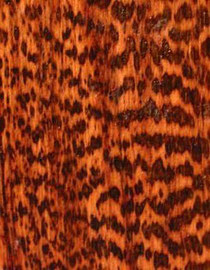
Snakewood is one of the most visually striking woods I work with. Its heartwood has a reddish-brown hue, sometimes marked with characteristic dark flecks that give it its naturally mottled appearance.
Dense, very hard, and capable of taking a beautiful polish, this species has been sought after for centuries in cabinetmaking and the decorative arts, particularly for making small pieces where its grain can be fully showcased.
Wood and its history
Wood with a naturally mottled pattern
The uniqueness of letterwood comes primarily from its pattern. Some trees develop dark patterns in their heartwood called speckles, which contrast with the wood's brown to reddish-brown background. Therefore, not all pieces have the same pattern intensity.
This characteristic appearance earned it the English name Snakewood, referring to the patterns that can resemble a snake's skin.

Where does snakewood come from?
- Common names: Amourette, speckled letterwood
- English name: Snakewood
- Botanical name: Brosimum guianense
- Family: Moraceae
- Origin: Tropical America
- Natural range: From southern Mexico to tropical South America
- Found particularly in French Guiana
Brosimum guianense primarily grows in humid tropical regions. Kew Science confirms a particularly vast natural distribution, including French Guiana, Suriname, Guyana, Brazil, Colombia, Peru, and Venezuela.
Did you know?
Snakewood is also called "letterwood". This name is thought to be linked to its former use in making wooden printing type. Its great hardness and fine grain allowed for the preservation of precise details despite repeated pressure.
Wood and hand
A particularly dense and hard wood
Snakewood is a very dense, hard, and compact wood. Its fine grain and hardness allow it to take a beautiful polish, but also make it more challenging to work with, especially during sawing and planing.
Snakewood in the arts and crafts
Snakewood is traditionally used in cabinetmaking, marquetry, and fancy goods to create small pieces and decorative objects: boxes, canes, handles, or veneers.
It also holds a special place in lutherie, where it is notably used for making violin bows.
Caractéristiques du bois
| Masse volumique | Environ 1 180 kg/m³ à 12 % d’humidité |
|---|---|
| Densité | Très élevée : l’amourette est plus dense que l’eau |
| Dureté | Très élevée |
| Grain | Fin |
| Finition | Peut prendre un très beau poli |
| Variations | Le dessin moucheté peut être très différent d’un morceau à l’autre |
Pour se faire une idée : avec une masse volumique d’environ 1 180 kg/m³, l’amourette fait partie des bois particulièrement denses. Sa densité étant supérieure à celle de l’eau, un morceau massif d’amourette coule au lieu de flotter.

Wood at Racines Artisanat
Where does the snakewood I work with come from?
The snakewood I use in my creations comes from scraps recovered from Hervé Guiraud, an antique furniture restorer, as well as from a luthier in Tarn-et-Garonne.
These pieces, which have become too small for their work, remain perfectly suited for making jewelry. A few centimeters are enough to highlight the characteristic speckled pattern of this wood.
Why did I choose snakewood for my creations?
Snakewood interests me primarily for its naturally speckled pattern. Depending on the part of the wood used, the patterns can be very prominent or, on the contrary, much more discreet: two pieces of jewelry made from the same piece can thus have a different appearance.
Its density and fine grain also allow for precise shapes and a particularly smooth surface after finishing.
It is a wood that particularly suits my way of working: the wood grain directly contributes to the design of the jewelry, without dye or added pattern.
Sources
-
CTBF Guyane — Amourette — wood description, speckles, density, hardness, uses in cabinetmaking and lutherie, "letterwood" appellation, and historical use for printing type.
-
Kew Science — Plants of the World Online : Brosimum guianense — accepted botanical name, Moraceae family, and natural geographical distribution, from southern Mexico to tropical America, including French Guiana.
-
CIRAD — Amourette or Letterwood — wood properties, hardness, fine grain, polishing quality, and traditional uses in marquetry, turnery, cabinetmaking, and jewelry.
Discover my snakewood creations...

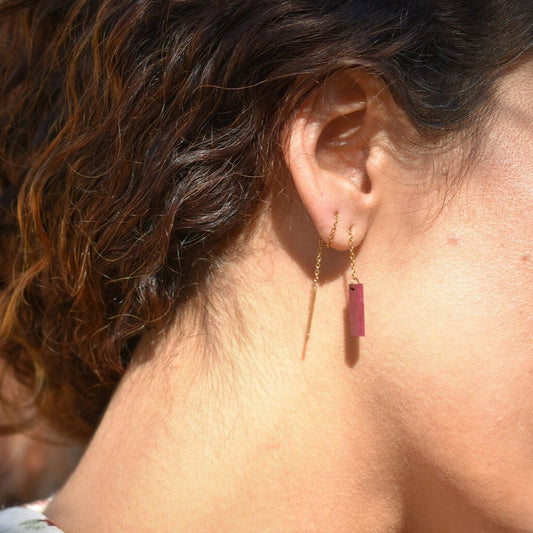
Multi-position wooden chains - Gold

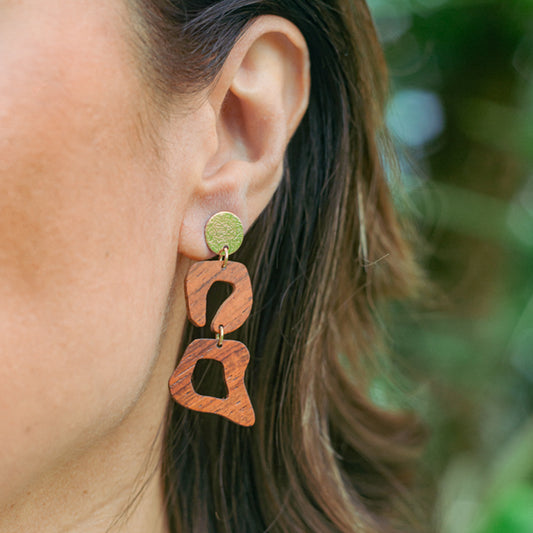
Leopard wood earrings - Gold

Precious wood jewelry
Unique and durable jewelry handcrafted from upcycled precious wood by master craftsmen...