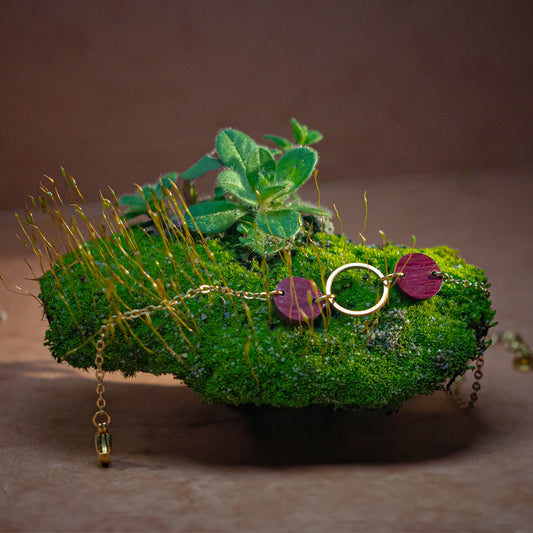
Amaranth wood
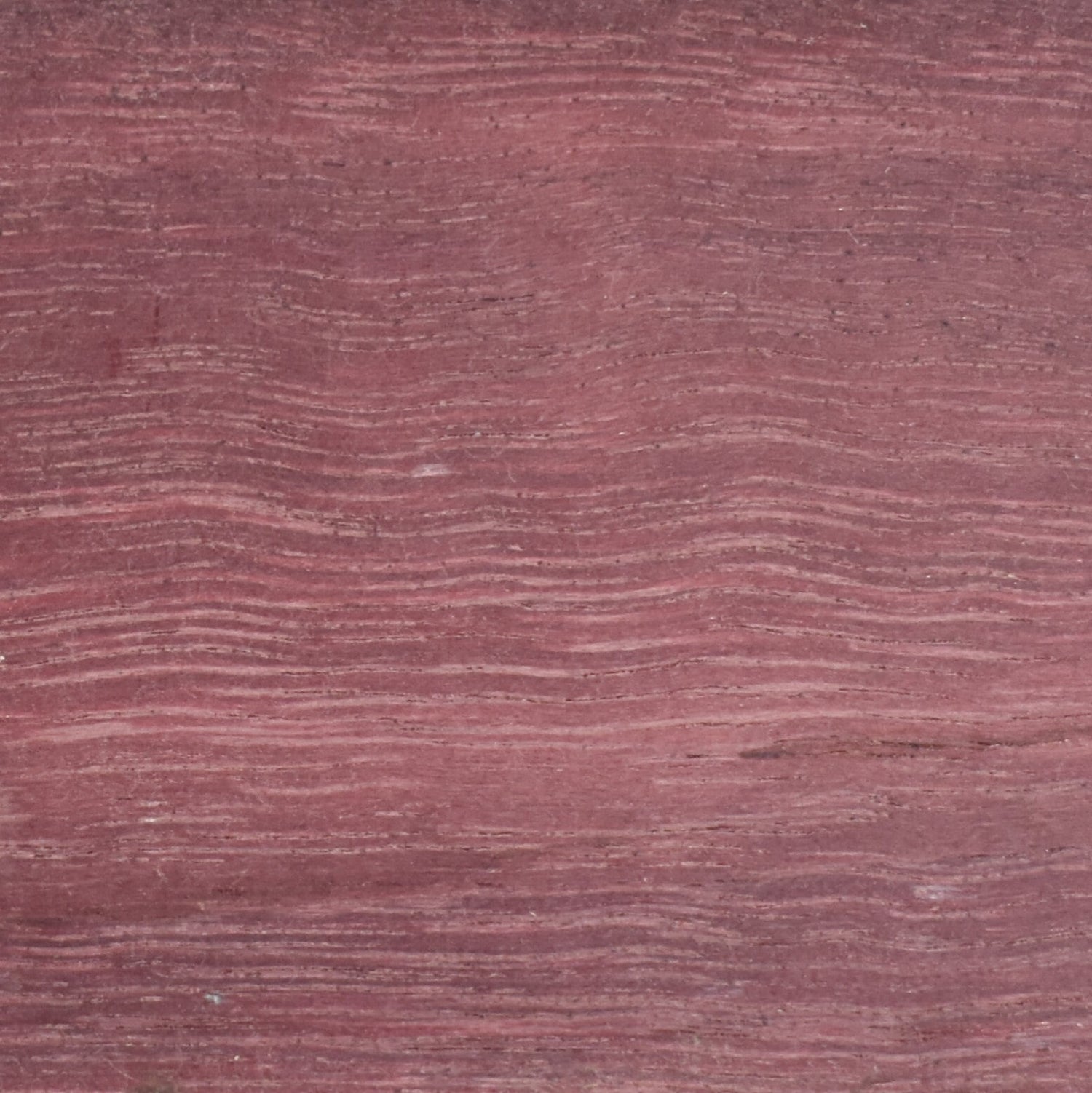
Amaranth is a wood species immediately recognizable by its naturally purple color. Dense and hard, it has long been used in cabinetmaking for its properties, but also for this particularly unusual color in wood.
It is one of the woods I regularly use in my jewelry, where its shade allows me to create purple pieces without resorting to any dye.
Wood and its history
A color that reveals itself over time
Amaranth’s color has the particularity of transforming after the wood has been worked.
Freshly cut or worked, the wood is much lighter. Depending on the species of Peltogyne, its shade can then range from brown to purplish-brown, before gradually taking on its characteristic purple color. CIRAD even describes, for some amaranths from Guyana, an almost white heart right after sawing.
The purple color appears naturally in contact with air and light, without any dye. With prolonged exposure to light, it gradually darkens and evolves towards more brownish tones.

Where does Amaranth come from?
- Common name: Amaranth, Purpleheart
- Botanical name: Peltogyne spp.
- Family: Fabaceae
- Origin: Tropical America
- Natural range: from Mexico, through Central America, to Southern Brazil
- Found notably in French Guiana
The name "amaranth" actually refers to several species of the genus Peltogyne with similar characteristics.
Did you know?
Purpleheart also has remarkable fire resistance for a wood. The CTBF French Guiana indicates a conventional French classification of M2, corresponding to "flame retardant," under the conditions provided for this classification. The USDA Forest Service also reports that Purpleheart burns slowly and has high fire resistance.
Wood and hand
A dense and particularly hard wood
Amaranth is a dense, hard and resistant wood. Its average density is 0.87 at 12% humidity and its Monnin hardness reaches 7.6.
Monnin hardness measures the wood's resistance to indentation: the higher this value, the harder the wood. Amaranth is thus among the particularly hard species.
Amaranth in cabinetmaking
Its hardness, resistance and natural color make it a popular species for furniture, marquetry, turning, veneer and various decorative objects.
For the cabinetmaker, its color also has a particular interest: it allows for natural contrasts with other species without the need for dyeing.
Caractéristiques du bois
| Masse volumique | Environ 870 kg/m³ à 12 % d’humidité |
|---|---|
| Densité | Élevée : c’est un bois dense et compact |
| Dureté | Très élevée |
| Grain | Fin à moyen |
| Fil | Généralement droit, parfois ondulé ou irrégulier |
| Finition | Peut obtenir une surface très lisse après ponçage |
Pour se faire une idée : avec une masse volumique d’environ 870 kg/m³, l’amarante est nettement plus dense que de nombreuses essences courantes. Les caractéristiques peuvent varier selon l’espèce de Peltogyne et les conditions de croissance.

Wood at Racines Artisanat
Where does the amaranth I work with come from?
The amaranth I use for my jewelry does not come from new wood purchased specifically for my creations.
I primarily work with amaranth scraps recovered from Hervé Guiraud, a restorer of antique furniture. These pieces, which have become too small to be reused in furniture restoration, are still perfectly suited for jewelry making.
The small size of my creations thus allows me to give value to precious wood pieces that would no longer necessarily have a use for other woodworking projects.
Why did I choose amaranth for my creations?
Amaranth interests me primarily for its color. Few wood species naturally offer such a striking purple hue, without any added coloring.
Its density and grain also allow for the creation of precise small forms. Depending on the piece used and its evolution, the purple can be more vibrant, deeper, or slightly brownish, giving each creation a different look.
It is also a wood species that particularly well illustrates what I love about woodworking: the color and character of the jewelry come directly from the material, and not from an added effect.
Sources
- CTBF Guyane — Amarante — wood characteristics, Peltogyne species, mechanical properties, uses, and presence in French Guiana.
- CIRAD – Bois et Forêts des Tropiques: Amarante Fact Sheet — identification, geographical distribution, anatomy, technological properties, and uses of amaranth.
- USDA Forest Service – Peltogyne spp. / Purpleheart — geographical distribution, natural color change, grain, texture, density, and wood properties.
Discover my amaranth wood creations...
-
Round wooden bracelet - Gold
Regular price €43,00Regular price -
Wooden Moon and Sun Hoop Earrings - Gold-Plated
Regular price €29,00Regular price -
Wooden daisy hoop earrings - Gold
Regular price €29,00Regular price -
Multi-position wooden chains - Gold
Regular price From €34,00Regular price